
A measurable content goal connects an audience outcome to a behavior you can observe and a decision you are willing to make. “Grow the account” is not a goal. “Increase the number of returning viewers who complete our weekly tutorial series, then decide whether to continue the format after eight episodes” is usable.
Start with the business or editorial job
Assign one primary job to the content:
- Discovery: help an appropriate new person find you.
- Attention: earn enough time to deliver the promised value.
- Trust: make your judgment and usefulness visible.
- Action: help a qualified person take a relevant next step.
- Retention: give existing readers, viewers or customers a reason to return.
Avoid giving one post five goals. A tutorial built for search discovery can still produce enquiries, but that does not make enquiries its fairest primary test.
Write the goal as a decision statement
Use this structure:
For [audience], publish [defined work] for [test period]. We expect [observable change] compared with [baseline]. If the result is [threshold or pattern], we will [decision].
Example:
For first-time mobile editors, publish six export troubleshooting videos over eight weeks. We expect a higher share of search discovery and stronger retention at the demonstrated fix than our previous general editing posts. If at least four videos show the pattern, we will build a permanent troubleshooting cluster.
This avoids inventing a universal benchmark. Your baseline is your own comparable work.
Choose one leading and one outcome measure
A leading measure tells you whether the work happened as designed: briefs completed, experiments shipped, or qualified distribution performed. An outcome measure shows audience response: retention, returning viewers, completed downloads, enquiries or revenue.
Platform metrics are not interchangeable. As of September 2026, YouTube documents reach metrics such as impressions and unique viewers, engagement metrics such as watch time and average view duration, and audience reporting that includes new, casual and regular viewers. It also notes that some data may be limited. Record the metric definition and reporting window with the number.
Use a comparison that answers something
Choose one:
- the previous six pieces with the same format and job;
- the same series before and after one controlled change;
- a channel’s typical performance for similar-length videos;
- a fixed cohort or reporting window.
Do not compare a 20-second Short with a 20-minute tutorial and call the difference a lesson about quality. YouTube’s own retention guidance supports comparing recent videos of similar length.
Add guardrails
A goal can improve one number while damaging the publication. Add two or three guardrails, such as correction rate, production hours, unsubscribe rate, rights risk, support load or audience mismatch. If a hook lifts starts but causes an early retention collapse, the experiment did not succeed.
Review on a useful rhythm
Do not redesign the plan after every post. Use a short weekly check for execution and a deeper review after enough comparable observations exist. At review time, record:
- What changed?
- Which audience segment or surface changed?
- What competing explanation exists?
- What will remain constant in the next test?
- What decision follows now?
Keep “continue,” “adjust,” “stop” and “insufficient evidence” as valid outcomes. Measurement is useful only when it changes a decision.
Preserve the original hypothesis
Save the goal before publishing and do not quietly rewrite it after seeing the result. Add a separate review note instead. This distinction protects you from turning any outcome into apparent success. If a metric definition changes during the test, close the old series, record the discontinuity and begin a new baseline rather than presenting unlike numbers as one trend.
Sources
- YouTube Help: Get started with YouTube Analytics
- YouTube Help: Understand your content performance
- YouTube Help: Understand your engagement
- YouTube Help: Understand your audience
Decision map
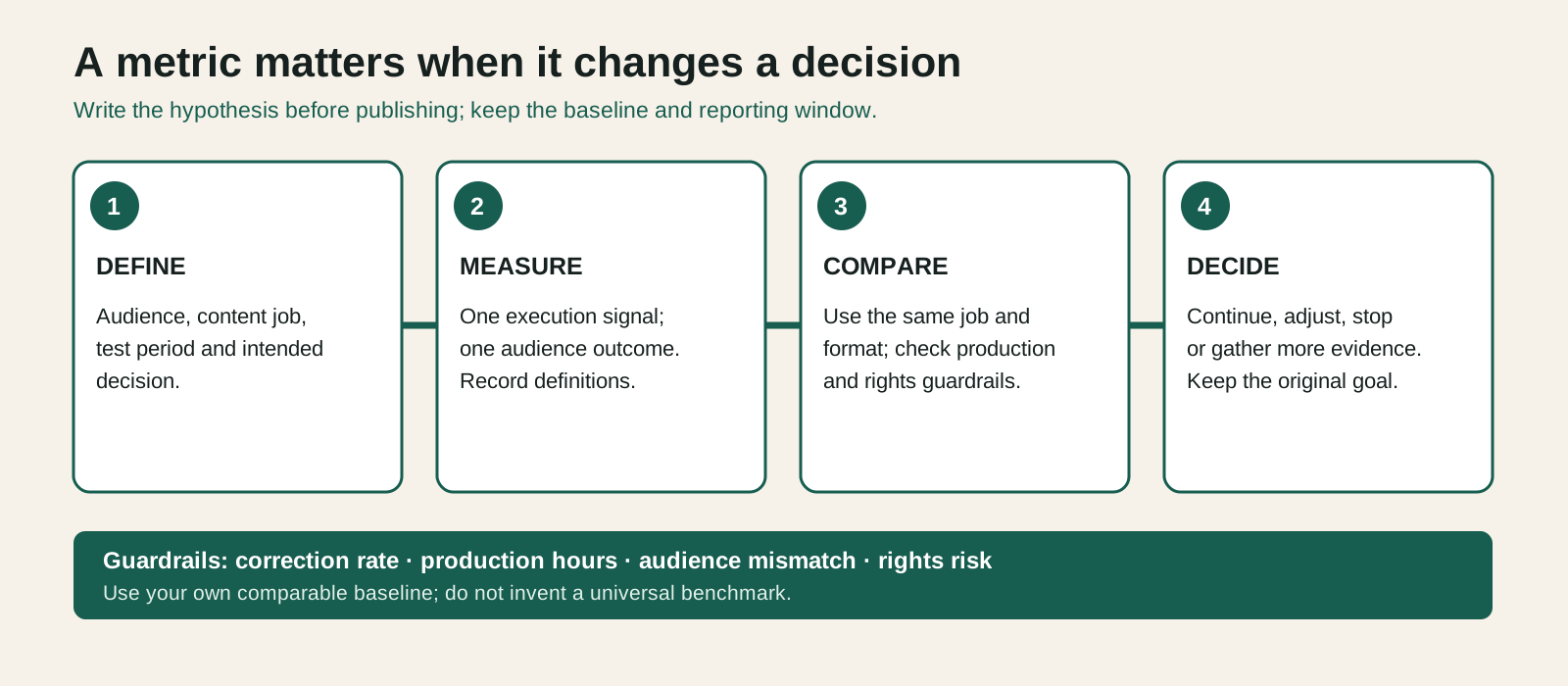
Open the diagram for a full-size view. Set the hypothesis and guardrails before publishing.