Platform risk is the possibility that access, distribution, revenue, data or workflow changes because a service changes rules, products, enforcement or availability. A creator cannot remove that risk and still benefit from platforms. The practical goal is to prevent one account or feature from becoming an unrecoverable single point of failure.
As of September 2026, treat every platform-specific interface and permission as changeable. Use the platform's current help and policy pages before acting on a high-stakes issue.
Map the dependency before choosing the backup
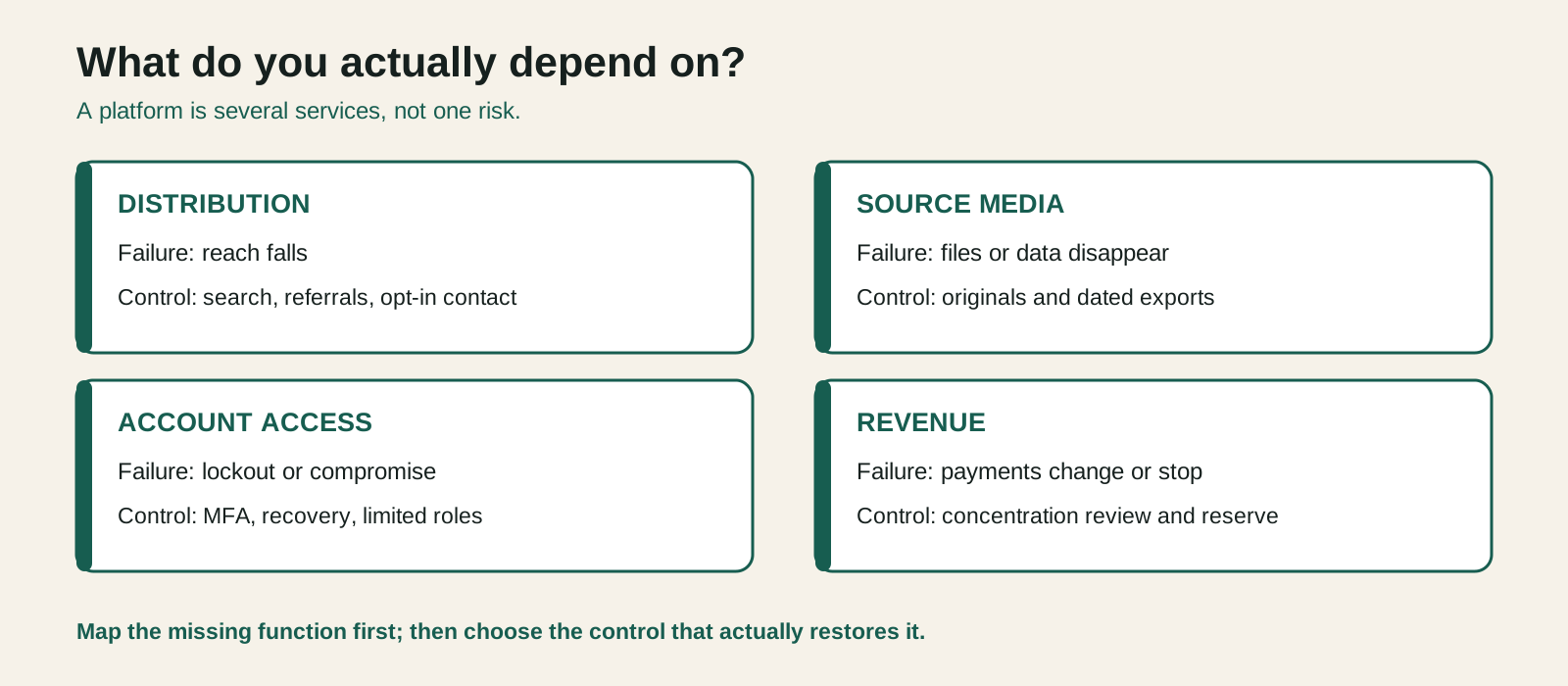
“Do not rely on platforms” is not useful advice. Creators need distribution. Instead, map what each platform currently provides:
- audience discovery;
- follower or subscriber access;
- publishing and hosting;
- source files or only processed copies;
- analytics and historical reports;
- comments, messages and community context;
- monetization and payment;
- identity or social proof;
- team permissions and recovery.
Then ask what happens if only that function disappears. A recommendation change is different from an account takeover. A removed editing feature is different from losing payment access. Each needs a different control.
Six platform-risk scenarios
1. Distribution falls
Reach can decline even when the account remains healthy. Do not diagnose one weak post as a system change. Compare several pieces with similar topics and formats, check official status or product notices, and separate audience fit from distribution.
The control is a portfolio of discovery paths: search-oriented evergreen resources, direct referrals, collaborations, email or another permission-based channel, and multiple platform formats where the content genuinely fits. Cross-posting everything everywhere is not diversification if every version depends on the same trend and audience behavior.
2. A feature or format changes
A platform may alter editing, analytics, music access, scheduling or monetization. Keep high-quality source files, captions, thumbnails, rights records and a delivery master outside the platform. Document the workflow rather than relying on muscle memory inside one interface.
When adopting a new feature, define an exit: how will you preserve the work, what alternative can deliver the core value, and which data should be exported regularly?
3. Policy or enforcement affects content
Maintain a current source for relevant policies and record which content decision it supports. Avoid “policy advice” copied from old creator posts. If content is removed, preserve the exact notice, URL, asset version, publication time and any appeal submission.
Do not build a response around evasion. Decide whether to correct, appeal with evidence, republish a compliant version elsewhere or retire the asset. Rights and safety issues may require qualified advice.
4. The account is compromised
Creators are exposed to convincing brand-deal files, fake copyright messages and credential phishing. YouTube's creator safety guidance explicitly recommends avoiding untrusted links and files, using stronger account protection, reviewing permissions and not sharing sign-in credentials. CISA recommends multifactor authentication and favors phishing-resistant methods where available.
Use unique credentials, secure the recovery email, store recovery codes safely and review connected apps. Grant role-based access instead of a shared password when the platform offers it. Remove former collaborators promptly. Record who owns the account and which device or person can recover it.
5. Data becomes inaccessible
Export analytics and account information on a schedule suited to decision value. Record metric definitions and export dates; platform metrics can be renamed or calculated differently later. Preserve source assets independently. A downloaded platform copy may be compressed or may omit project structure and rights evidence.
YouTube currently documents both individual downloads for uploaded videos and Google Takeout for broader export. The page also lists conditions where a download may not be available, which is another reason not to treat the platform copy as the master.
6. Revenue stops or changes
Track revenue concentration by platform and by buyer. Platform payments, affiliate programs and sponsorship demand can change for different reasons. Maintain cash reserves appropriate to the business, understand payment timing and avoid committing fixed expenses against one volatile stream.
Diversification should add operationally compatible revenue, not five unrelated jobs. A creator with deep tutorials might combine sponsorships, a scoped service and a useful paid resource. Each still needs a disclosure, delivery and support process.
Build an owned layer
“Owned audience” does not mean you own people. It means you control a lawful communication and publishing layer more directly than an algorithmic feed. Examples include a website with durable URLs, an opt-in email list, a customer system and downloadable products with clear access terms.
The owned layer should provide independent value. A website made only of thin summaries that send everyone back to a social platform is another dependency wrapper. Publish complete resources, maintain corrections and give people a reason to return directly.
Collect only data you need and can protect. Explain what happens after signup, provide a working unsubscribe path and align the privacy notice with actual processors and analytics.
Define a portability pack
For each important content property, keep:
- original media and editable project files;
- final masters in documented formats;
- captions, transcript and alt text;
- titles, descriptions and thumbnails;
- public URLs and publication dates;
- license, consent and disclosure records;
- analytics exports with metric definitions;
- account ownership and permissions inventory;
- audience contact data only where lawfully collected;
- a map of high-value evergreen resources.
Back up the pack separately. Test whether another person can restore one representative project and understand the permissions without asking the original creator.
Use a platform-risk register
Review quarterly and after important product changes.
| Dependency | Failure scenario | Impact | Existing control | Next action | Owner |
|---|---|---|---|---|---|
| Primary video channel | account takeover | critical | MFA, roles, recovery record | test recovery contacts | owner |
| Native editor | project format unavailable | high | exported master | preserve originals/project notes | editor |
| Platform analytics | history window changes | medium | monthly export | document definitions | analyst |
| Music catalogue | track unavailable for reuse | high | license record and clean master | keep replaceable music stem | editor |
Score impact and recoverability separately. A high-impact risk with a tested recovery may be acceptable. A moderate-impact dependency with no export or owner may deserve immediate attention.
Create a response playbook
Write the first actions before an incident:
Compromised account: use a clean device, follow official recovery, secure email and connected apps, preserve evidence, notify affected partners through a verified channel.
Content removal: save the notice, identify the exact rule, collect source/rights evidence, pause automated reposting, decide correction or formal appeal.
Distribution shock: verify data quality, compare a relevant sample, continue serving existing audience, test one variable, strengthen direct discovery rather than publishing panic volume.
Feature retirement: export while access remains, freeze a working process, test the alternative with one representative project, document migration gaps.
What not to do
- Do not share passwords when scoped permissions exist.
- Do not use a platform download as the only archive.
- Do not buy followers or use policy-evasion tactics to compensate for lost reach.
- Do not tell the audience a policy changed without linking and dating the primary source.
- Do not add an email list without privacy, consent and operational ownership.
- Do not diversify into more platforms than the team can maintain accurately.
Platform risk becomes manageable when dependencies are visible, recovery is tested and the creator's source assets and audience promise survive an interface change. The aim is not independence from platforms. It is the ability to make a deliberate next move when one platform changes the terms of the day.
Related resources
Sources
- YouTube Help: Safety tips and resources for YouTube creators
- YouTube Help: Add or remove access with channel permissions
- YouTube Help: Download videos you uploaded
- CISA: Require Multifactor Authentication
- CISA: Data Backup Options
Decision Flow